Synthehol.ai vs Data Masking: Why Masking Alone Is No Longer Enough for Banking AI

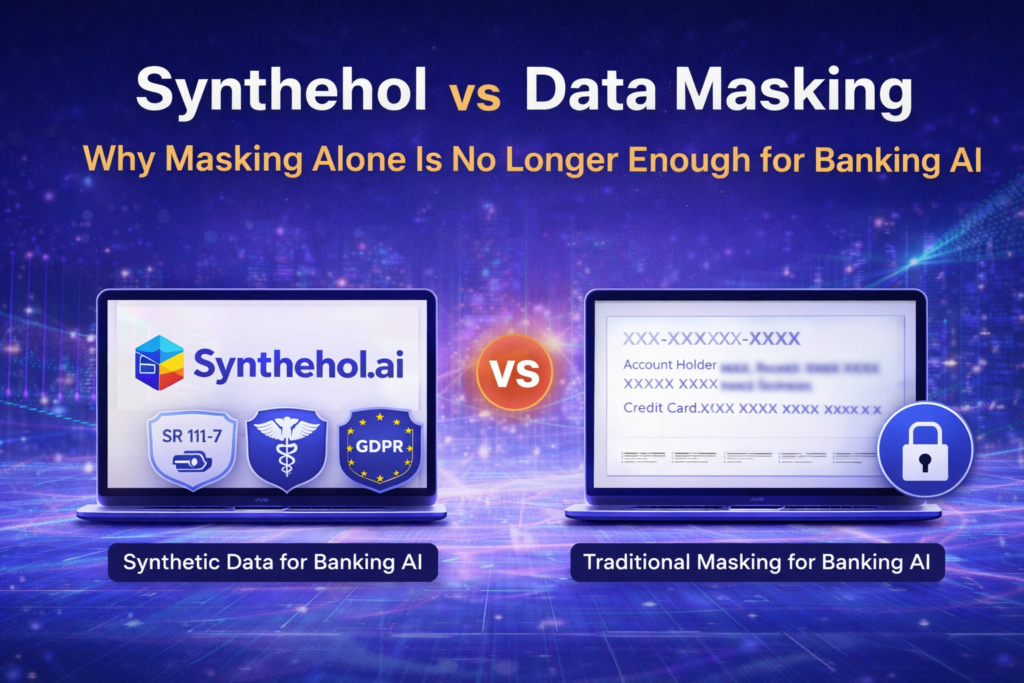
Table of Contents
Synthehol vs Data Masking: Banking AI
Data masking has been the default answer to how banks use sensitive data safely for more than a decade. It is embedded in policies, vendor contracts, and database workflows.
However, as banks push more real data into AI models, model validation processes, and vendor sandboxes, masking is showing its limits. These limits are increasingly visible in SR 11-7 reviews, failed fraud model deployments, and stricter vendor risk assessments.
Synthehol.ai Synthetic Data Platform and data masking are not the same category of solution. Understanding the difference, and knowing when masking is sufficient versus when synthetic data is required, is one of the most important data architecture decisions banks will make in 2026.
High-Level Comparison
| Dimension | Synthehol.ai Synthetic Data Platform (LagrangeDATA.ai) | Data Masking |
|---|---|---|
| What it does | Learns statistical structure and generates new synthetic records that never existed in production | Transforms real records by replacing, scrambling, or generalizing sensitive fields |
| Real data dependency | No real PII in output. Synthetic records are entirely new | Output still derives from real records |
| Statistical fidelity | 90 to 95 percent fidelity with automated validation evidence | Varies widely. Strong masking often destroys statistical relationships |
| Re identification risk | Structural privacy because synthetic records were never real | Residual re identification risk always exists |
| ML and model training suitability | High. Preserves joint distributions, correlations, and conditional dependencies | Often low. Masking breaks correlations and removes behavioral signals |
| Documentation for regulators | Automatic validation pack per run designed for SR 11-7 and HIPAA documentation | Masking audit logs available but statistical quality rarely validated |
| Rare event preservation | Can generate and oversample rare events such as fraud or defaults | Cannot generate new rare events |
| Deployment | On premise, air gapped, zero external dependencies | Often integrated into ETL or database tools |
The Fundamental Limitation of Masking for AI
Data masking was designed to solve a specific problem. It prevents unauthorized readers from seeing raw personally identifiable information. Masking replaces, encrypts, or generalizes fields such as names, social security numbers, or account identifiers.
For that specific purpose, masking works well.
However, banking AI requires something masking was never designed for. It requires statistically faithful data for model training, validation, and risk analysis.
When masking becomes aggressive enough to reduce re identification risk, several problems usually appear.
Correlations between features break. For example, the relationship between income bracket and default probability can change when income values are generalized or scrambled.
Rare event distributions become distorted. Fraud patterns and default clusters often represent the most valuable signals for risk models.
Behavioral sequences in time series data flatten. Transaction patterns and utilization trends that models rely on may disappear.
The result is a dataset that appears realistic but behaves differently under statistical analysis. Models trained on masked data frequently perform worse in production environments.
Where Data Masking Still Works
Data masking is not obsolete. It remains the right solution in several situations.
When the use case is access control and not machine learning or analytics. A support agent might need to view a customer record but should not see the social security number.
When the downstream consumer does not require statistical accuracy. A developer testing a user interface does not need representative income distributions.
When strict schema preservation is required. Masked data must maintain exact formats, data types, and referential integrity.
When masking augments an existing pipeline where replacing masked data with synthetic data is not yet feasible.
For these situations, masking platforms such as Delphix, Informatica, or IBM Optim remain appropriate.
The issue appears when masking becomes the default solution for AI model training and validation use cases it was never designed to support.
Synthehol.ai Approach: Replace Masking Where It Breaks
Synthehol.ai Synthetic Data Platform does not compete with masking in the access control layer. Instead, it replaces masking as the data source for machine learning, model risk, and analytics workflows that require statistical fidelity.
For model training datasets, Synthehol.ai generates synthetic training data that preserves joint distributions and class imbalances without introducing masking artifacts.
For SR 11-7 model validation, Synthehol.ai produces validation ready datasets with formal statistical evidence including KS tests, correlation matrices, and composite metrics.
For fraud and credit scenario analysis, Synthehol.ai can generate synthetic fraud waves, default clusters, and stress scenarios that may not exist in historical data.
For vendor and partner sandboxes, synthetic datasets allow collaboration without exposing real PII. The data has no lineage to real customers.
The result is not a modified version of real data. It is new synthetic data that preserves statistical behavior while remaining privacy safe.
The Re Identification Risk Gap
One of the most overlooked differences between masking and synthetic data is re identification risk.
Masked data carries inherent residual risk because it originates from real records. With sufficient auxiliary information such as public datasets or leaked data, attackers can sometimes reconstruct identities.
This risk has already been the basis for multiple GDPR enforcement cases and HIPAA breach investigations.
Synthetic data generated by the Synthehol.ai Synthetic Data Platform does not share this lineage problem. Synthetic records never corresponded to real individuals or accounts.
Because there is no original person to map back to, the privacy risk model becomes structurally different and in many interpretations more defensible.
FAQ: Synthehol vs Data Masking
Can Synthehol.ai replace data masking completely in a bank?
For machine learning, model risk, and analytics use cases the answer is often yes. Synthetic data provides better statistical fidelity. For access control scenarios where users must see partial records, masking still remains appropriate. Many banks deploy both approaches.
Is synthetic data always safer than masked data?
From a re identification perspective, well generated synthetic data can be safer because there is no real record to reconstruct. However synthetic data still requires privacy validation. Synthehol.ai performs similarity analysis and nearest neighbor checks automatically during each generation run.
What happens to statistical relationships in Synthehol.ai synthetic data?
Synthehol.ai preserves joint distributions, pairwise correlations, and conditional dependencies at approximately 90 to 95 percent fidelity. These are the statistical properties that masking techniques frequently degrade.
Bottom Line
Data masking solved an important problem. It prevented unauthorized users from seeing raw personally identifiable information.
Synthetic data solves a different problem. It provides AI, risk, and analytics workflows with statistically faithful and privacy safe data that models can learn from.
For banks entering 2026 with stronger SR 11-7 scrutiny, expanding AI model portfolios, and stricter vendor risk requirements, the Synthehol.ai Synthetic Data Platform fills the gap masking was never designed to address. It provides automated synthetic data generation, formal statistical validation evidence, and on premise deployment that keeps all processing inside the bank’s security perimeter.