Why Your Staging Environment Is a Legal Risk You Haven’t Noticed Yet

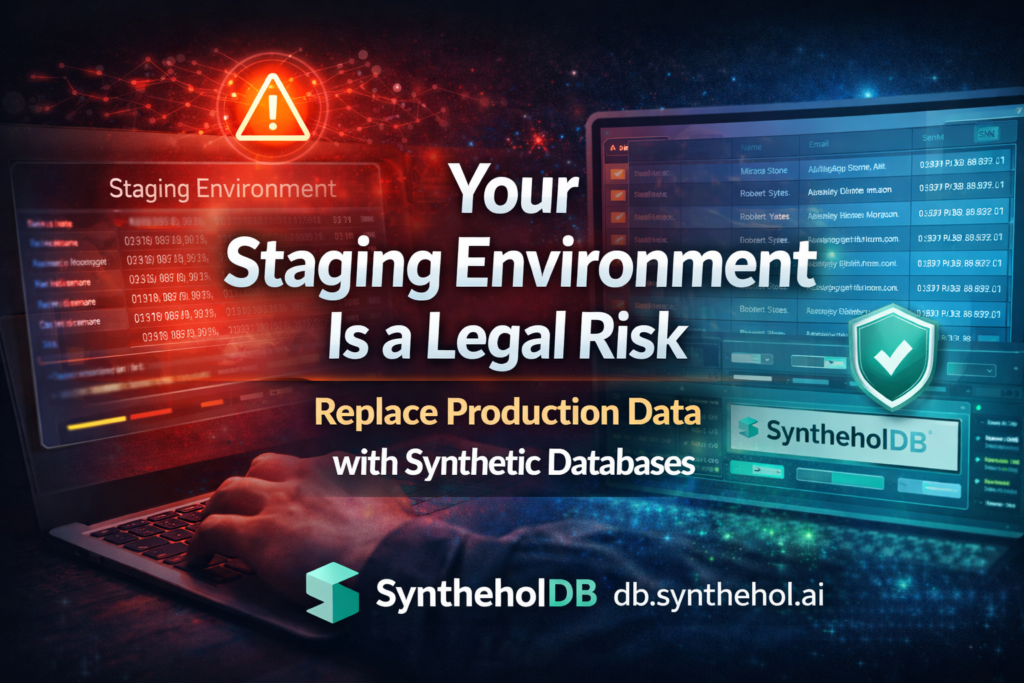
Let me tell you about the breach that never makes the news.
It doesn’t start with a nation-state hacker or a zero-day exploit. It starts with a developer on a Monday morning who needs realistic data to debug a payment flow. So they do what developers have always done they grab a slice of production, drop it into staging, and get to work.
By noon, genuine customer names, real email addresses, live Social Security Numbers, and actual transaction histories are sitting in an environment with no audit logging, loose access controls, and contractor access across three time zones.
By the time legal finds out if they ever do, the exposure has been sitting there for months.
I built LagrangeData.ai because I kept seeing this happen. And I kept watching smart companies learn about it the worst possible way.
The Staging Problem Is Structural, Not Behavioral
Every engineering team I’ve spoken to has a version of the same story.
Someone copies a production database “just once” to get a realistic dataset for a demo. That copy lives on a developer’s laptop for six months. Or it gets pushed to a staging S3 bucket that someone accidentally leaves public. Or it moves through a CI pipeline, gets logged by a third-party observability tool, and now a vendor you’ve never audited holds copies of your customer data.
This isn’t a people problem. It’s a structural one. The architecture of most software development workflows creates an almost irresistible pull toward real data in non-production environments because real data works, and synthetic alternatives historically haven’t been good enough to trust.
That’s the problem we set out to solve.
What the Law Actually Says, And Doesn’t Exempt
GDPR, HIPAA, CCPA, and most modern privacy regulations do not carve out exceptions for staging, dev, or QA environments. If you hold PII, you are accountable for it on every server it touches.
GDPR Article 5 requires personal data to be limited to what is strictly necessary for the purpose it’s collected for — a principle called data minimization. Copying 800,000 live customer records into a test environment to validate a checkout modal is almost certainly indefensible under this standard.
HIPAA’s Security Rule applies to all electronic Protected Health Information, full stop. “It was only in our dev environment” has never once held up as a mitigating argument with an HHS auditor.
CCPA gives California consumers the right to know how their data is used. If your privacy policy doesn’t disclose that customer data is routinely copied into development environments accessed by offshore contractors, you have a disclosure problem — even if no breach ever occurs.
The fines are real and large. Amazon: €746 million. British Airways: £183 million, partly traceable to a vulnerability that originated outside production. Regulators are not lenient because the exposure happened in the wrong tier of your infrastructure.
Manual Masking Is Not a Defense
Some teams respond to this risk by masking scripts find-and-replace for names, SSNs, and email addresses before the data lands in staging.
It sounds reasonable. It rarely works.
A developer masks users.email but misses orders.contact_email. Another redacts SSNs in the primary table but leaves them intact in the audit log. Someone replaces names but leaves precise GPS coordinates that uniquely identify an individual’s home address.
I’ve seen all of this. Regulators and breach investigators have too. “We attempted to anonymize it” is not a defensible posture when the anonymization is incomplete, inconsistently applied, or reversible. Especially when it was done informally by an individual developer rather than through a governed, auditable process.
Partial masking doesn’t reduce your liability. It just creates the illusion of compliance while the real risk persists underneath.
The Only Durable Fix: Structurally PII-Free Environments
The answer is not better masking. The answer is making your non-production environments architecturally incapable of containing real PII not by policy, but by design.
This is what synthetic data generation makes possible.
At LagrangeData.ai, we built SyntheholDB specifically to close this gap. Instead of copying production records and hoping scripts catch every exposure surface, your teams generate a completely new dataset from scratch. The data behaves like production same statistical distributions, same referential integrity, same business logic patterns — but it has never been near a real customer record. There is nothing to breach, nothing to mask, and nothing to disclose.
SyntheholDB extends this to your database layer directly. Upload your schema or describe your data model in plain English. Configure row counts, value distributions, and column relationships. SyntheholDB generates thousands of realistic, relationally consistent rows — foreign keys resolve correctly, salary scales with tenure, order values align with customer tier. Every output passes through a built-in PII detection scan before export, so even statistically unlikely collisions with real-world data get caught before the file leaves the tool.
From schema to seeded, demo-ready database: under five minutes.
The Audit Question You Should Be Asking Today
If you’re an engineering leader, here’s a simple test: ask your developers where the data in your current staging environment came from.
Don’t frame it as an accusation. Just ask. Track down the origin of every table in every non-production environment you operate.
I’d estimate that in more than 70% of companies, the answer will involve production data — either directly copied, partially masked, or “anonymized” by a process nobody has reviewed in two years.
If you’re in legal or compliance, staging data governance almost certainly isn’t covered in your current privacy policy, your vendor agreements, or your incident response plan. It needs to be.
The tools to fix this are faster, simpler, and cheaper than most teams expect. The regulatory and reputational cost of not fixing it is not.
A Different Way to Build
The companies that are getting ahead of this aren’t just adopting synthetic data as a compliance checkbox. They’re adopting it as a development philosophy — one where the default assumption is that no environment below production ever needs to see a real customer record.
That shift makes development faster, not slower. Developers can generate edge-case datasets on demand. QA teams can test against adversarial data patterns that would be impossible to extract from production. Demo environments can be spun up and torn down without any legal exposure.
It also changes your relationship with compliance teams — from adversarial gatekeepers to enablers who are confident the data pipeline is clean by construction.
Your staging environment isn’t a legal gray area. It’s a liability you’re probably carrying right now.
🔒 If you want to see exactly how fast you can replace production data in your non-prod environments — generate your first synthetic database free in under 5 minutes at db.synthehol.ai. No schema required to start. No sales call. Just clean data, instantly.