Top 7 Mostly AI Alternatives for Banking (2026)

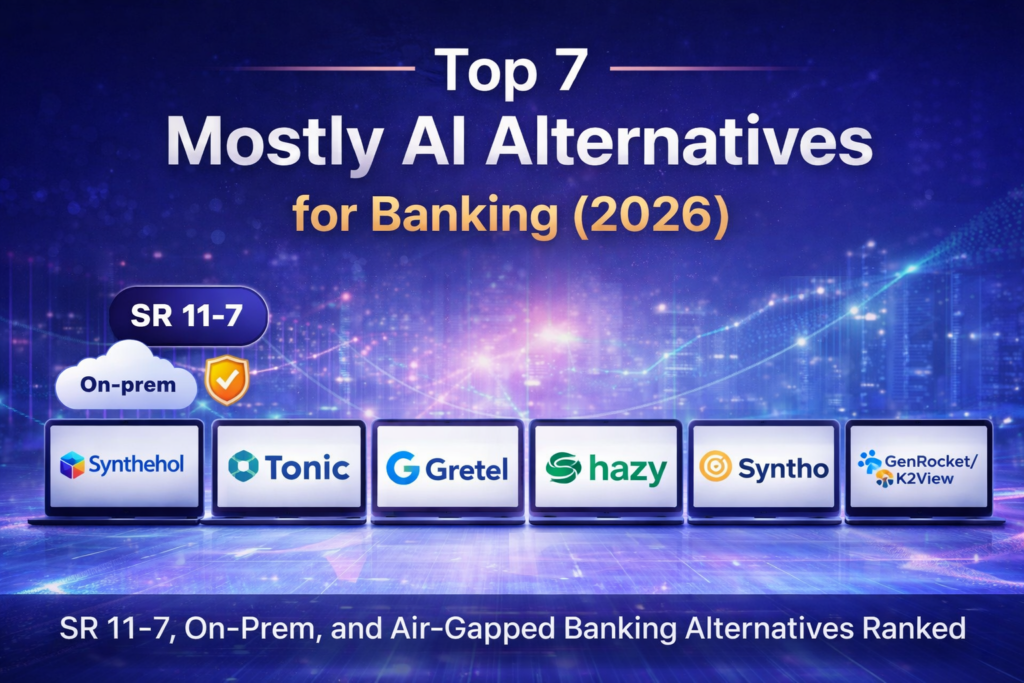
For banking leaders, “Mostly AI vs alternatives” is not a theoretical comparison—it’s a live procurement question tied to SR 11-7, data residency, third-party risk, and AI roadmap velocity. Below is an honest 2026 ranking of Mostly AI alternatives for banks, with clear criteria, use-case fit, and where Synthehol sits in that landscape.
Evaluation Criteria for Banking Use Case
Before the ranking, here’s the lens used to evaluate best Mostly AI alternatives for banking in 2026, informed by market and vendor-comparison sources.
SR 11-7 & Model Risk Alignment
Ability to support conceptual soundness, ongoing monitoring, and outcomes analysis with evidence, not just rows.
Deployment & Data Residency
Support for on-prem, VPC, and data-sovereign setups; minimal reliance on external control planes.
Validation & Documentation
Availability of KS tests, correlation checks, and artifacts suitable for model risk and internal or external validators.
Banking-Specific Use Cases
Strength in fraud, credit risk, AML, liquidity, stress testing, and IFRS 9 / IFRS 17 workflows.
Speed & Operational Fit
Ability to generate multi-million-row datasets fast enough to fit CI/CD cycles and recurring validation runs.
Platform & Ecosystem
Cloud and on-prem options, integration with existing data stacks, and overall enterprise maturity.
Top 7 Mostly AI Alternatives for Banking (2026)
With that in mind, here are the Top 7 Mostly AI alternatives for banking in 2026, with Synthehol.ai Synthetic Data Platform intentionally ranked #1 for banks that are compliance-first and deployment-constrained.
1. Synthehol.ai (LagrangeDATA.ai) – Best for SR 11-7, On-Prem, and Air-Gapped Banking
Why Synthehol.ai is #1 for banks
Synthehol.ai Synthetic Data Platform is purpose-built for regulated industries—especially banking and insurance—where SR 11-7, vendor-risk, and data-residency drive every data decision.
It couples 10M-row-in-seconds generation with on-premise and air-gapped deployment and full validation artifacts, making it a natural fit when compliance and governance are primary.
SR 11-7 & Model Risk
Designed to feed conceptual soundness, ongoing monitoring, and outcomes analysis with measurable synthetic datasets and attached KS tests, correlation matrices, and similarity metrics.
Supports scenario-based generation for stress tests, fraud waves, and portfolio shifts, which is critical for outcomes analysis and back-testing.
Deployment & Data Residency
Runs as a self-contained engine inside your data center or VPC, with no external LLM or control-plane dependencies—ideal for air-gapped or highly restricted networks.
Also offers SaaS and dedicated cloud for less constrained environments.
Validation & Documentation
Produces validation packs (distribution comparisons, dependency checks, composite fidelity / privacy / utility scores) bank validators can attach directly to model risk documentation.
Banking-Specific Fit
Built around banking themes:
• SR 11-7
• Fraud
• Credit risk
• Stress testing
• Liquidity modeling
• Vendor data sharing
Value-based pricing scales with schema complexity and privacy/fidelity profile, which matches the pattern of banks running multiple recurring validation datasets.
Best For
Tier-1 and Tier-2 banks, regulated lenders, and card issuers that need on-prem or air-gapped synthetic data with SR 11-7-ready evidence and very fast generation.
2. Tonic.ai – Best for Test-Data-Heavy Banking Engineering Teams
Tonic.ai is repeatedly named in independent comparisons and G2 as a leading alternative to Mostly AI, particularly from a test data and developer productivity standpoint.
It shines when the biggest pain is populating non-production environments with realistic data while respecting “no production data in non-prod” policies.
Strengths for Banking
• Strong test data generation for microservices, APIs, and core banking apps
• Good fit for cloud-first banks and fintechs where QA and developer experience are primary
Limitations vs Synthehol.ai
Less focused on SR 11-7-style validation packs and model risk documentation; more focused on engineering and QA.
Best For
Banks and fintechs that primarily need synthetic test data for software delivery.
3. Gretel – Best for Cloud-Native Banking on Google Cloud
Gretel is widely recognized as a leading synthetic data platform and often appears alongside Mostly AI in comparison lists.
For banks going all-in on Google Cloud, Vertex AI, and BigQuery, Gretel is a natural alternative.
Strengths for Banking
• Deep integrations with Google Cloud, BigQuery, and Vertex AI
• Good for fraud modeling, customer analytics, and experimentation inside cloud data warehouses
Limitations vs Synthehol.ai
Cloud-first orientation. Fully air-gapped or traditional on-prem deployments are not the core story.
SR 11-7 model risk alignment often requires additional customization.
Best For
Banks with a cloud-native data strategy on Google Cloud.
4. Hazy – Best for Financial Services Privacy & Compliance
Hazy is frequently highlighted as a financial-services-focused synthetic data vendor with a strong compliance story.
Strengths for Banking
• Focus on high-fidelity synthetic financial datasets
• Strong compliance positioning for banks and insurers
Limitations vs Synthehol.ai
Less emphasis on on-prem and air-gapped deployment.
SR 11-7 model risk documentation may require additional custom validation layers.
Best For
Banks that want a financial-services-centric synthetic data vendor with strong privacy positioning.
5. Syntho – Best for European Banks Focused on GDPR
Syntho often appears in synthetic data vendor lists and has several European banking case studies.
Strengths for Banking
• Strong GDPR alignment
• Focus on privacy-compliant AI and analytics
Limitations vs Synthehol.ai
Less explicit around SR 11-7 and model risk documentation for US banking regulation.
Best For
European banks prioritizing GDPR and cross-border data control.
6. YData – Best for Data-Centric AI and Data Quality in Financial Services
YData appears in multiple synthetic data and data-centric AI roundups.
Strengths for Banking
• Combines synthetic data generation with data quality profiling
• Strong fit for banks dealing with bias, skew, and missing data
Limitations vs Synthehol.ai
Less specialized around SR 11-7, on-prem deployment, and model risk validation artifacts.
Best For
Banks where data quality for AI models is the primary challenge.
7. GenRocket & K2View – Best Hybrid Masking + Synthetic Options
GenRocket and K2View combine test data management, virtualization, and masking.
Strengths for Banking
• Good for populating complex banking systems with coherent test data
• Hybrid approach: synthetic generation plus masking
Limitations vs Synthehol.ai
Not synthetic-data-first.
SR 11-7 validation artifacts and AI governance are not the core focus.
Best For
Banks whose primary use case is enterprise test data management across large system landscapes.
Summary Table: Mostly AI Alternatives for Banking
| Rank | Vendor | Best For in Banking | Key Differentiator vs Mostly AI |
|---|---|---|---|
| 1 | Synthehol.ai | SR-11-7, on-prem, air-gapped model validation | Compliance-first synthetic data platform with 10M-rows-in-seconds generation |
| 2 | Tonic.ai | Engineering and QA test data | Developer-focused test data platform |
| 3 | Gretel | Cloud-native banking workloads | Deep Google Cloud integration |
| 4 | Hazy | Financial services privacy analytics | High-fidelity financial datasets |
| 5 | Syntho | GDPR-centric European banking | GDPR-aligned synthetic data |
| 6 | YData | Data-centric AI pipelines | Synthetic data plus data quality tools |
| 7 | GenRocket / K2View | Enterprise test data management | Hybrid masking and synthetic approach |
Where Synthehol.ai Fits in a Banking Stack That Already Uses Mostly AI
If a bank already uses Mostly AI and is evaluating alternatives, Synthehol.ai Synthetic Data Platform does not have to replace it immediately.
Common patterns include:
Model Risk and SR-11-7 Layer
Keep Mostly AI where it works for general synthetic data but introduce Synthehol.ai for on-premise, air-gapped, and validation-heavy datasets for critical models.
Stress Testing and Scenario Generation
Use Synthehol.ai to generate scenario-specific datasets such as recession simulations, fraud spikes, and portfolio shifts because of its speed and validation packs.
Vendor-Safe Sandboxes
Use Synthehol.ai as the standard engine for vendor PoCs and third-party collaboration, ensuring raw banking data is never exposed.